Attendance control: what DT Exempt Resolution 38 requires
What Chile's Labor Directorate Exempt Resolution No. 38/2024 regulates, its key requirements, how to check whether a system is authorized and what to ask a provider.
Law 21.561, which amended Chile’s Labor Code to reduce working hours, added a mandate to article 33 for the Labor Directorate (DT): to set the conditions and requirements for electronic attendance and working-time recording systems. The DT did so with Exempt Resolution No. 38 of April 26, 2024, published in the Official Gazette on May 9, 2024. This guide summarizes its official text.
What it regulates
The resolution applies to electronic attendance recording platforms, not to paper-based methods such as a logbook, nor to mechanical devices. Its definition is broad: it covers any platform, device or application used, directly or indirectly, to obtain information on attendance, hours worked or rest periods, even if that is not its main purpose. The text itself gives the example of a messaging app used to report the start or end of the workday.
It distinguishes two steps:
- Certification: a technical review by a company independent of the developer, the vendor and the employer, which concludes that the platform meets every requirement. It must be repeated every 24 months.
- Authorization: granted by the DT through an official letter (Ordinario) from its Legal Department. It applies to the system, not to the company that sells it, and lasts two years from the date of the Ordinario.
Authorizations for general systems issued under the previous rules remained valid until April 26, 2025, unless they expired earlier.
Main requirements
The full list is long. These are the points that most affect day-to-day operations:
- Identification: at least two ways to recognize workers, and one of them must not use biometrics or personal data. The employer defines the primary and backup methods in the employment contract or internal rules.
- Integrity: every clock record generates a hash or checksum (SHA-2 is recommended) that can be verified online.
- Online transmission: records are sent to a central database. Where there is no permanent connection, a record may be captured and sent automatically once the signal returns, but only in exceptional, justified cases.
- Receipts: workers automatically receive a printable receipt for each record at their personal email address.
- Inspection portal: a secure website available 24/7, with permanent access for DT inspectors.
- Worker access: workers can see all their records at any time, with at least five years of history.
- Reports: attendance, daily working hours, Sundays and holidays, shift changes, a daily report and technical incidents, exportable to Excel, PDF and Word.
- Corrections: the employer may only change or add records in the cases the rules allow. The system notifies the worker by email, who has 48 hours to object.
- Alerts and blocking: alerts for missing records and for schedules that exceed legal limits. Blocking workers from recording does not comply with the rules.
- Personal data: written consent for data such as fingerprints, and destruction between 90 and 120 days after the employment relationship ends.
The employer must also keep the system’s information available for up to five years, even after changing providers.
How to check whether a system is authorized
The DT publishes on its website the list of attendance recording systems that comply with Exempt Resolution No. 38. For each system it shows the name, the company, the Ordinario number, the authorization date, the expiration date and the certifying entity. The resolution requires the list to be updated monthly.
When checking it, confirm that the name matches the system being offered exactly (renaming the solution requires a new authorization) and that the expiration date has not passed.
The DT adds two warnings: it authorizes systems, not the companies that sell them or their users, and its authorization does not prevent the employer from being inspected and sanctioned if violations are found. Using an unauthorized electronic system is also one of the violations the resolution lists.
What to ask a provider
- What is the Ordinario number of the authorization, and when does it expire?
- Which entity certified the system?
- What are the two identification methods, and which one does not use biometrics?
- How does it work without signal, and how are those records synchronized?
- How do inspectors and workers access the information?
- How are record corrections logged and notified?
- How is personal data handled and destroyed?
- If I change providers, how do I retrieve the history?
- If the authorization is canceled, how will I be told? The resolution requires providers to inform their clients within 5 business days.
SmartClock
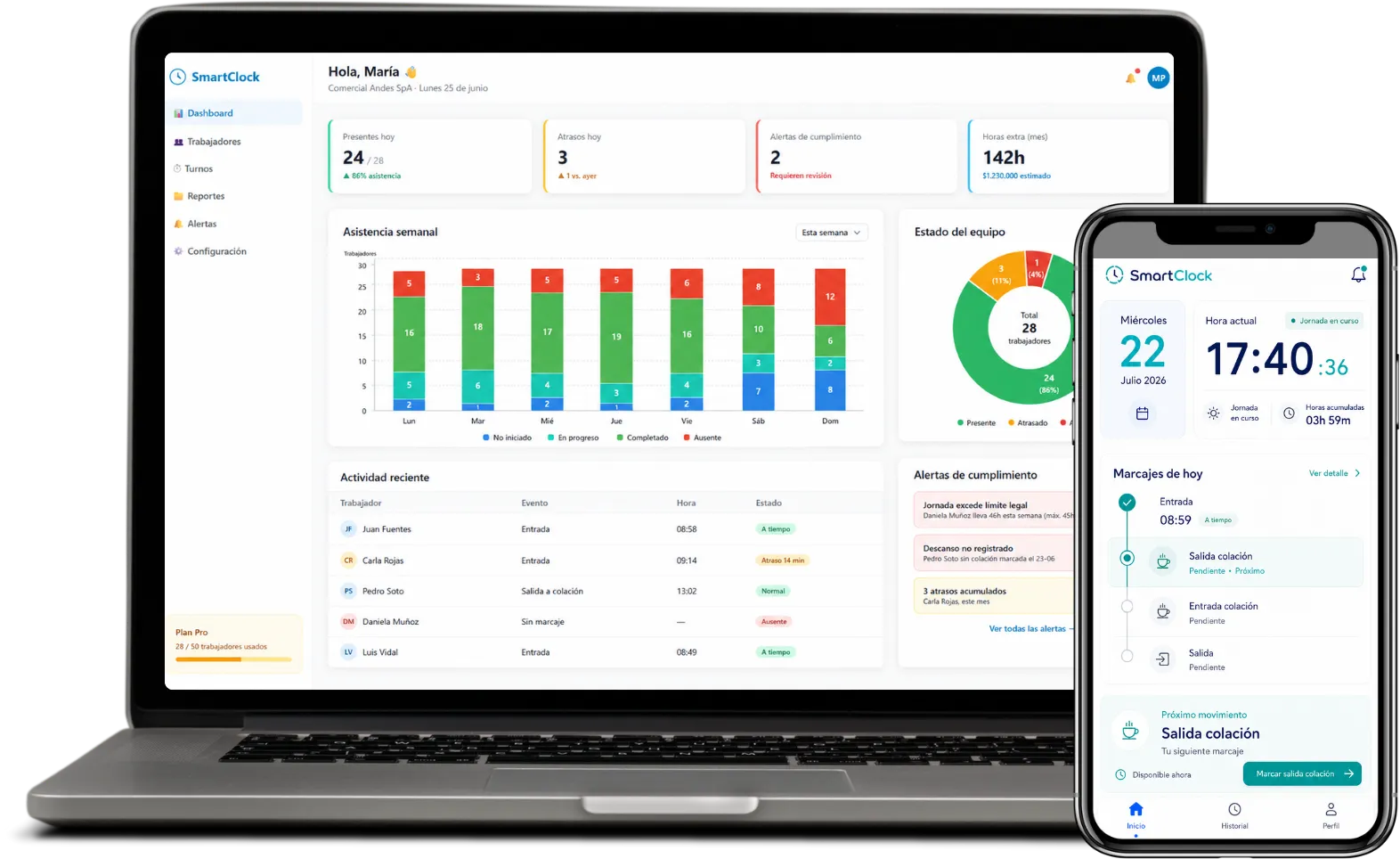
SmartClock, BWhale’s attendance control system, is undergoing certification by Chile’s Labor Directorate (Exempt Resolution No. 38/2024). Once the DT authorizes it, it will appear on that list; until then, this article’s advice applies to us as well: check the status of any system at the official source.
Sources
All documents are in Spanish.